
01
Suspected seizures or convulsions
To look for electrical patterns that may support the assessment of a seizure disorder when interpreted with the event description.

Electroencephalography • Brain Electrical Activity Recording
An EEG records the brain’s electrical activity and can help a neurologist assess seizures and selected neurological events.
An EEG is a non-invasive test in which small electrodes are placed on the scalp to record the brain’s electrical signals. The test itself does not send electricity into the body and does not use ionizing radiation. The type and duration of recording depend on the clinical question and the patient’s needs.
Direct answer
An EEG, or electroencephalogram, records electrical activity from the brain through electrodes placed on the scalp. A neurologist reviews the waveforms, their distribution and timing, and interprets them in the context of the reason for testing, symptoms and medical history.
One of the best-known uses of an EEG is to support the assessment of seizures and epilepsy. It may also be used in selected cases involving altered awareness, events during sleep or other neurological questions determined by the treating clinician.
When might a neurologist consider the test?
Not every neurological symptom requires an EEG. The decision depends on the event, the clinical context and the specific question the clinician is trying to answer.
01
To look for electrical patterns that may support the assessment of a seizure disorder when interpreted with the event description.
02
Especially when episodes recur or their nature cannot be clarified from history alone.
03
An EEG may be requested when short recurring events need to be distinguished from other causes.
04
EEG or Video EEG can be useful for selected nighttime events, while sleep-breathing disorders may require a sleep study (PSG).
05
It may be used in specific circumstances to review electrical patterns or answer a defined diagnostic or management question.
06
Continuous EEG monitoring may be used in some patients with impaired consciousness or suspected seizures that are not clinically obvious.
The type depends on the clinical question
It is useful to separate recording method and duration from the patient’s age or testing location. Children, for example, may undergo different EEG types depending on the clinical need.

Linking an event to the EEG recording
Video EEG combines an EEG recording with synchronized video. It can help the neurologist compare what happens during an event with electrical changes recorded at the same moment.
How Video EEG is interpreted →A common first recording
A relatively shorter recording, often while awake. It may include opening and closing the eyes, deep breathing or flashing-light stimulation when appropriate.
To capture sleep or add information
A clinician may request sleep recording or a sleep-deprived EEG when sleep could provide additional information or when events are related to sleep.
Longer recording time
The recording may continue for hours or longer when events are intermittent or when a longer sample of wake and sleep activity is needed.
Portable recording for suitable cases
A portable recorder may be used in selected cases to record brain activity for longer periods outside the laboratory, depending on the required setup and suitability of the patient.
Home EEG details →A longer recording is not automatically “better”; the appropriate type is the one that can answer the clinical question.
What happens during the test?
The details vary by recording type, but the general process is straightforward.
The head is measured, electrode positions are identified and electrodes are attached using suitable conductive paste or adhesive.
The electrodes detect electrical signals while the patient sits or lies down quietly.
The team may ask the patient to open and close the eyes, breathe deeply or look at a flashing light when clinically appropriate.
The recording is reviewed and the waveforms are interpreted in relation to symptoms, medical history and any synchronized video.
Before your appointment
Final instructions depend on the EEG type. Do not stop medication or reduce your sleep on your own; follow the instructions provided for your specific appointment.
Understanding the report
The report describes patterns seen during the recording. Their meaning depends on the clinical situation, so an EEG result should be interpreted in context rather than in isolation.
The neurologist reviews the background electrical activity, distribution across the scalp, changes during sleep or activation procedures and patterns that may have clinical significance.
With Video EEG, electrical changes can be compared with what appears on video at the same time, which can be helpful when the nature of events is unclear.
Read common EEG result questionsNot necessarily. Some changes may be nonspecific or related to age, sleep or the clinical context. Epilepsy is not diagnosed from the EEG alone.
The next step may be clinical follow-up, a longer recording, Video EEG, imaging or another investigation depending on the case.
See when EEG may be requestedDifferent tests answer different questions
These tests are not substitutes for one another. A clinician selects them because each provides a different kind of information.
EEG
Records electrical brain activity over time and is particularly relevant to selected seizure and altered-awareness evaluations.
CT
Uses X-rays to show brain structure and is useful in different clinical settings, including selected urgent situations.
MRI
Uses a magnetic field and radio waves to image tissues. It may be requested alongside EEG when structural information is needed.
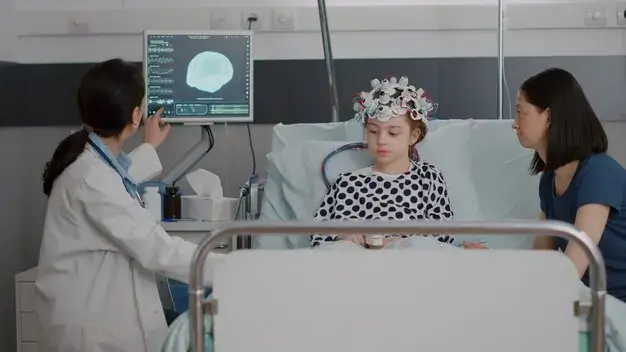
For infants and children when medically indicated
Hair usually does not need to be cut, and the electrodes do not send electricity into the head.
Children may undergo a routine EEG, sleep EEG or a longer recording depending on the clinical question. In some cases, sleep preparation is one of the most important parts of planning the appointment.
Portable recording for suitable patients
Home EEG is not simply moving a short test into a house; selected patients may need longer recording in a more natural environment.
Ambulatory or home EEG can be considered in selected cases, particularly when a longer recording is needed or travel is difficult. Recording quality, equipment and the clinical question determine whether a home setting is suitable.

Video explanation
These videos are supplementary educational material and do not replace medical assessment or the preparation instructions for your specific EEG appointment.
A video explanation of the role of EEG in recording electrical brain activity and situations in which a clinician may request it.
Open on YouTube →Preparation guidance and why instructions may vary depending on the EEG type.
Open on YouTube →EEG testing in Cairo
Before booking, tell the team why the EEG was requested, the patient’s age and whether the request specifies a routine, sleep, prolonged or Video EEG. This helps the team confirm the appropriate setup instead of booking the wrong type of recording.
Heliopolis
Contact the team before visiting to confirm appointment availability and the EEG type available at the location.
Confirm Heliopolis booking →Nasr City
Confirm the branch, appointment and required recording setup when booking.
Confirm Nasr City booking →Suitable cases
Ask the team about home coverage and the equipment required for the requested EEG type.
Home EEG information →Interpretation matters as much as the waveform
The role of an EEG is to add useful information to the clinical assessment, then connect the report to symptoms and the follow-up plan.
Related information
Use these links to move directly to the most relevant part of this guide or to booking and broader neurology care information.
Questions patients ask before the appointment
Send the test name written on the medical request, or a clear photo of the request, and the team can help you confirm the required preparation before booking.