
Especially when accompanied by choking, gasping or witnessed pauses in breathing.
Better sleep starts with understanding what happens overnight
Sleep Study in CairoPolysomnography / PSG
A structured assessment of sleep stages, breathing, oxygen and other physiological signals depending on the type of study
A sleep study in Cairo may help clarify symptoms such as loud snoring, witnessed breathing pauses, excessive daytime sleepiness, repeated awakenings or unrefreshing sleep. The appropriate test — a home sleep apnea test or a full polysomnography study — depends on the symptoms and medical assessment.

Overnight assessmentSignals are recorded while you sleep, according to the study type
Home or sleep centerThe choice depends on the patient and the diagnostic question
Medical interpretationThe report is interpreted together with symptoms and medical history
Could your sleep need a closer assessment?
When might a Sleep Study in Cairo be considered?
One symptom alone does not automatically mean you need testing. The medical assessment determines whether a sleep study is appropriate and which type is most useful.
Or waking suddenly with a choking or breathless sensation.
Despite apparently adequate sleep duration, or with marked morning fatigue.
Fragmented sleep or a persistent feeling that sleep is not restorative.
Movements that may disrupt sleep continuity and quality.
Particularly when associated with snoring, fatigue or daytime sleepiness.
If the problem is unclear, clinical assessment is a better first step than booking a sleep study at random. Similar symptoms can have different causes, and the appropriate sleep test varies from one patient to another.
From assessment to interpretation
How does a Sleep Study in Cairo work?
The process starts by selecting the appropriate study and ends with medical review of the recorded data.
Select the study type
Based on symptoms, medical history and the reason for testing.
Set up sensors or device
The measurements differ between a home test and full PSG.
Sleep and recording
The required physiological signals are recorded during the sleep period.
Analyze the data
Sleep, breathing, oxygen and movement data are reviewed according to the study.
Discuss the results
The findings are linked to symptoms and the next step in care.
Location is not only a matter of convenience
Home sleep test or overnight study at a sleep center?
The two are not equivalent. Selected adults can be assessed with a focused home sleep apnea test, while other patients need the broader measurements available with full polysomnography.
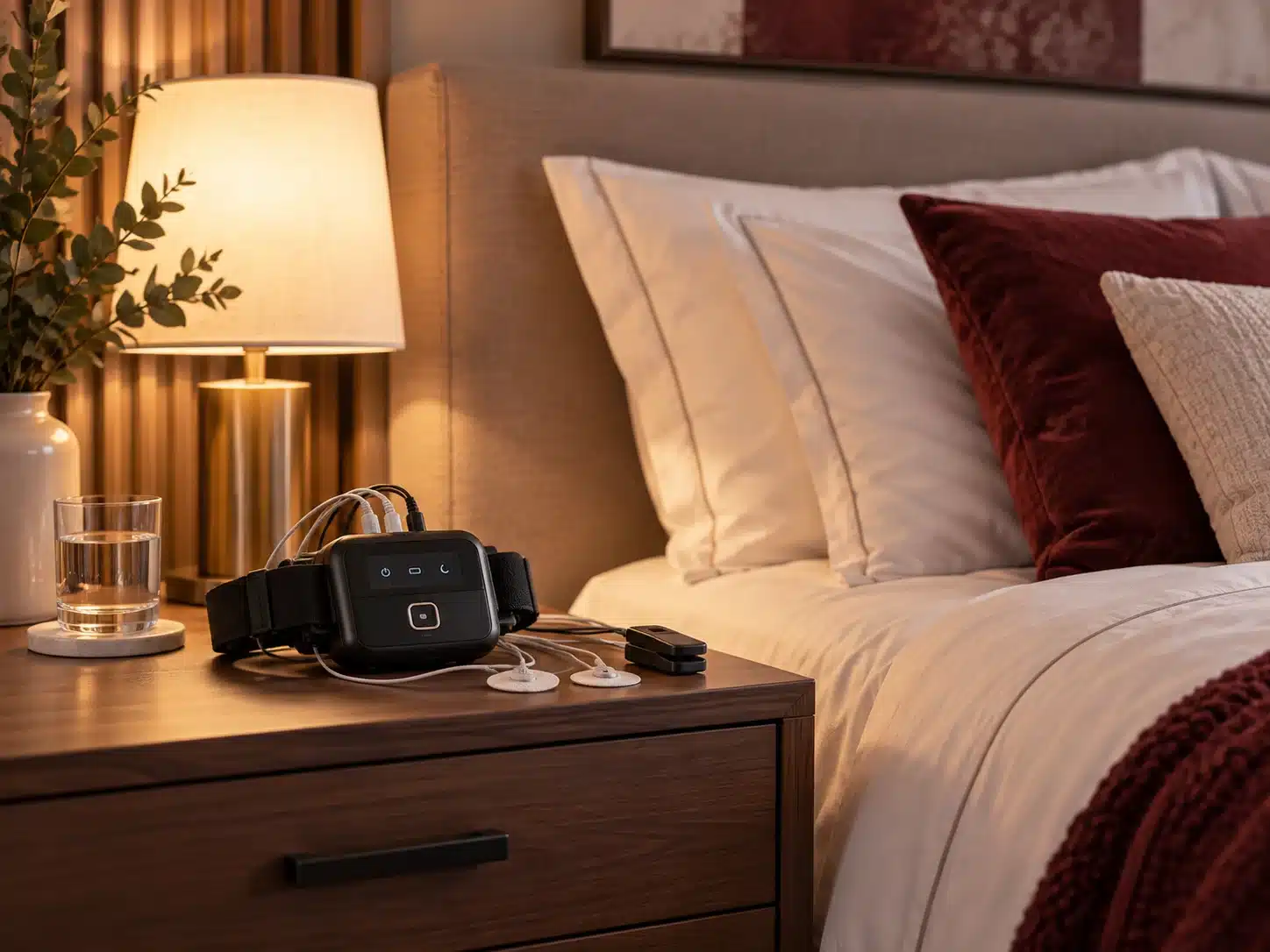
HOME SLEEP APNEA TEST
Home sleep apnea testing
For selected medically uncomplicated adults with an appropriate clinical suspicion of obstructive sleep apnea, a clinician may choose a portable home sleep apnea test (HSAT).
- Performed in the usual sleep environment.
- Uses fewer sensors than full polysomnography.
- Suitability should be determined clinically and it is not appropriate for every patient.
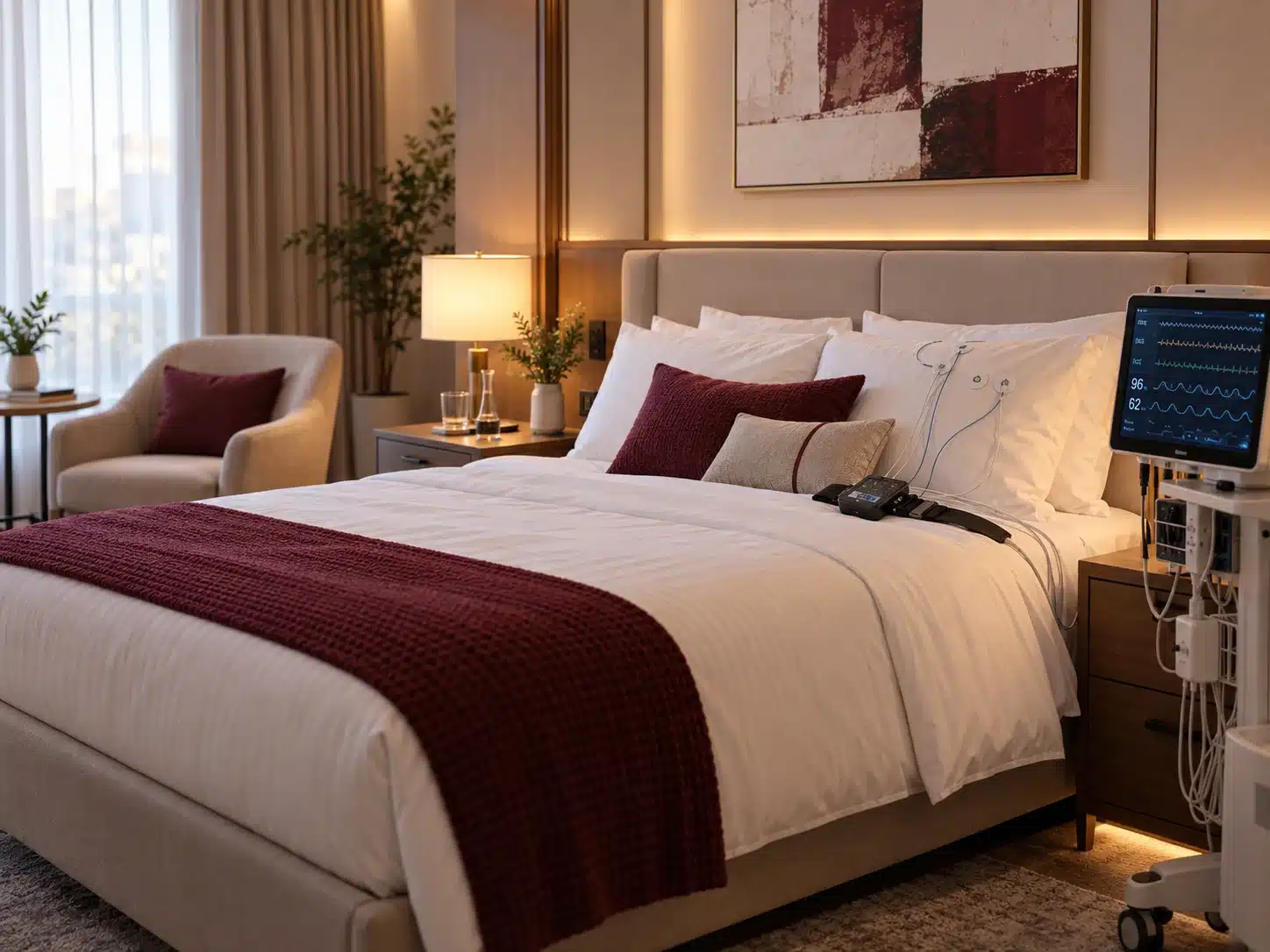
OVERNIGHT PSG
Full polysomnography at a sleep center
Full PSG records a broader set of signals and may be more appropriate when the clinician needs information about sleep stages, movement, breathing, oxygen and other physiological measures.
- Broader overnight monitoring of sleep stages and body signals.
- Useful when the clinical question requires measurements not provided by a home test.
- The clinician decides whether PSG is needed based on the patient’s symptoms and health context.
The result is more than one number
What can a sleep study measure?
The measurements depend on the type of study. Full PSG records more physiological signals than a home sleep apnea test.
Brain waves and sleep stages
In full PSG, EEG and other signals help identify sleep stages and transitions.
Heart rate and cardiac activity
Changes in heart rate can be monitored through the night as part of the study.
Breathing and airflow
The study can track breathing patterns, airflow and breathing effort depending on the protocol.
Blood oxygen level
Oxygen saturation is monitored and interpreted alongside the other recorded signals.
Two different tests
What is the difference between PSG and a home sleep apnea test?
The question is not which test is always “better,” but which one can answer the relevant medical question safely and appropriately for that patient.
Polysomnography PSG
A full sleep study may record brain waves, eye movements, breathing, oxygen saturation, heart rate, limb movement and body position. It can be used to assess a broader range of sleep disorders depending on the clinical question.
- Provides information about sleep stages themselves.
- Uses more sensors and measurements.
- Preferred when a broader sleep assessment is needed.
Home Sleep Apnea Test HSAT
A focused home test used mainly in selected medically uncomplicated adults when obstructive sleep apnea is appropriately suspected after clinical assessment.
- Usually does not measure all signals included in full PSG.
- It is not a general sleep test for everyone who snores or sleeps poorly.
- Raw device data requires appropriate medical review and interpretation.
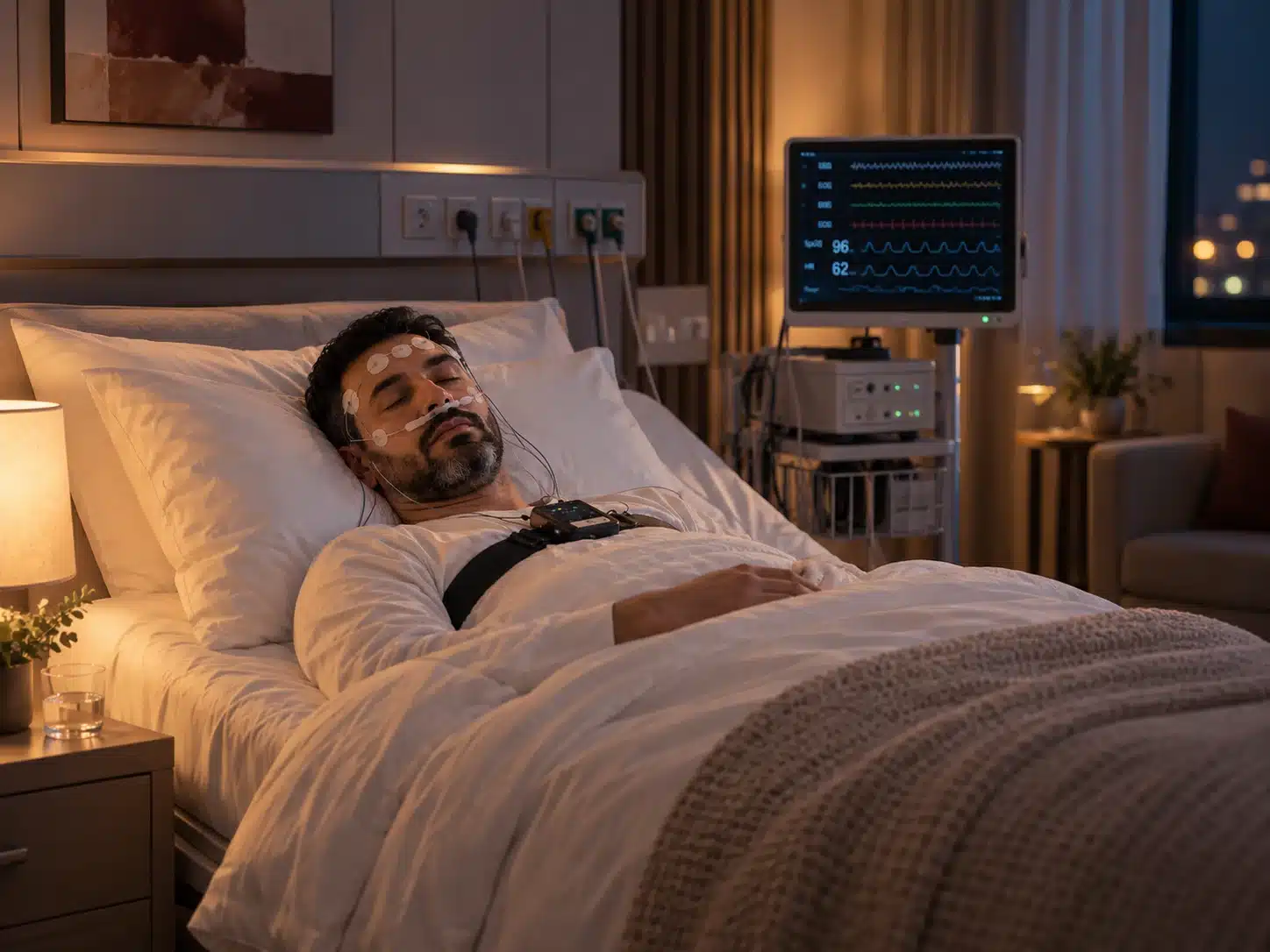
What happens during the night?
What should you expect during a sleep study?
The goal is to record sleep that is as representative as reasonably possible while monitoring the physiological signals relevant to the clinical question.
- Before sleepThe plan is explained and sensors are attached, or you are shown how to use the home device.
- During sleepThe equipment records the required signals without continuous interaction from you.
- If you need to moveAt a sleep center, staff can help organize or temporarily disconnect selected wires when appropriate.
- After recordingSensors are removed or the home device is returned, then the recorded data is reviewed and analyzed.
Simple preparation can improve recording quality
How to prepare for a Sleep Study in Cairo
Final instructions can vary by study type, medications and health conditions. Follow the instructions given for your specific appointment.
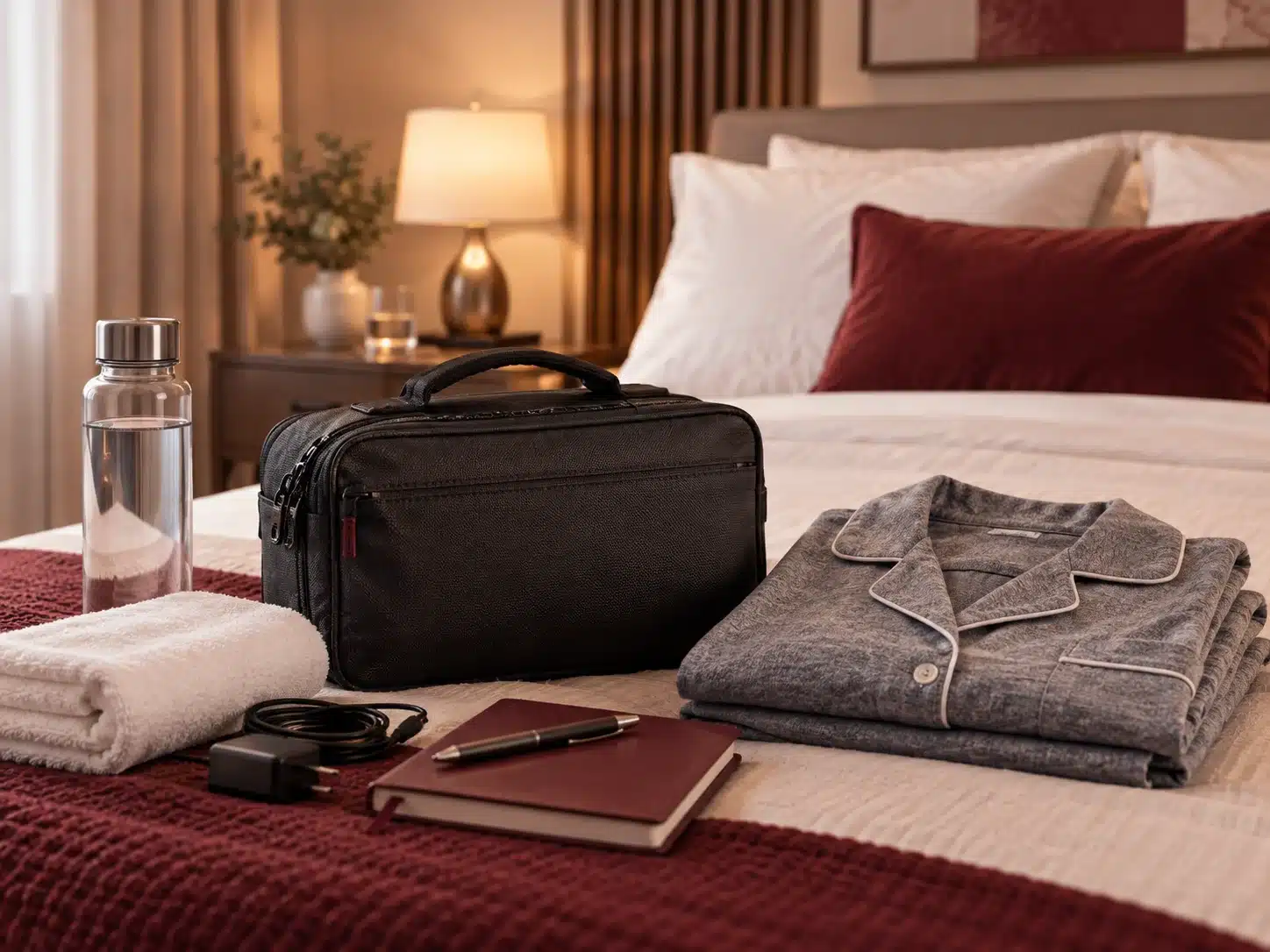
Before the study night
- Do not stop medication or sleep medication on your own; ask the clinician or testing team first.
- Follow instructions about caffeine, naps and sleep timing on the day of testing.
- Shower if instructed and avoid lotions, gels or products that may interfere with sensor attachment.
- Bring comfortable clothing and personal items if the study will be performed at a center.
- For home testing, make sure you understand how to attach, operate and return the device.
Introduction to sleep studies and related diagnostic tests
A short educational video introducing diagnostic testing and when a clinician may consider a sleep study.
After the recording
How are Sleep Study in Cairo results interpreted?
A sleep study report combines multiple related measurements rather than relying on one number or an automatic app-generated diagnosis.
The full pattern matters
After reviewing the recording, the findings are interpreted together with symptoms, medical history and the reason for testing. The study may identify a pattern that needs follow-up, help quantify severity or guide further evaluation.
- Review breathing patterns and measurable breathing pauses when present.
- Review oxygen saturation and heart-rate changes during the recording.
- With full PSG, analyze sleep stages, movements and other recorded signals.
- Determine whether the data adequately answers the clinical question or further assessment is needed.
BreathingHow breathing changes during sleep and whether measurable pauses occur.
OxygenHow stable blood oxygen remains through the recording.
Sleep stagesAvailable with full PSG when brain waves and eye movements are recorded.
MovementLimb and body movements can be measured depending on the study type.
After the report
What happens after the sleep study result?
The result supports medical decision-making; it does not replace clinical assessment or determine treatment automatically.
Discuss what was recorded and how it relates to the original sleep problem.
This may involve follow-up, lifestyle measures, specific treatment or another test depending on the diagnosis.
Some conditions need later follow-up to assess symptoms and response to the management plan.
Assessment before selecting the test
Dr. Karim Ashraf — Consultant Neurologist
Selecting an appropriate sleep study starts with understanding the symptoms and the medical question. NeuroVisit can coordinate sleep studies and selected home diagnostic services, with medical review of the result in the context of the patient’s care plan.
- Doctorate in Neurology — Ain Shams University
- Neurophysiology certification — Cleveland Clinic
- Neurology and neurophysiology assessment
Related information
Explore sleep and related diagnostic services
Continue to information about sleep problems, neurological testing and booking.
Before booking
Frequently asked questions about a Sleep Study in Cairo
Short answers to common questions. Final instructions depend on your individual situation and the type of study requested.
Is a sleep study painful?
A sleep study is generally non-invasive and uses external sensors and recording equipment. Wires or belts can feel unfamiliar, but the test is not designed to cause pain.
Does every sleep study need to be done at a sleep center?
No. Home sleep apnea testing is appropriate for selected patients, while full PSG requires a center or appropriately equipped environment to record a broader set of signals.
Is a home sleep apnea test equivalent to full PSG?
No. Home testing is usually more focused on sleep-related breathing and uses fewer sensors. Full PSG can record sleep stages and additional physiological signals.
Does snoring alone mean I need a sleep study?
Not always. Snoring is common. The need for testing depends on its severity and associated features such as breathing pauses, choking or excessive daytime sleepiness.
Should I stop sleep medication before the study?
Do not stop medication on your own. Tell the clinician or testing team about all medicines and supplements, and follow the instructions given for your specific study.
What if I cannot sleep well during the test?
This can happen because of the environment or sensors. Whether the recording is adequate is determined after the data is reviewed. Do not change medication or take extra sleep medication without guidance.
Can I move or go to the bathroom during an overnight study?
At a sleep center, staff can assist with selected wires and sensors when needed. Instructions depend on the setup and study type.
When will I receive the result?
Reporting time depends on the type and duration of the study and the amount of data that must be reviewed. The team can provide the expected timeframe when you book.
Can children have sleep studies?
Yes, pediatric sleep studies are available in appropriate settings, but the type and protocol must be selected for the child’s age and clinical situation. Home testing is not an automatic substitute for full PSG in children.
Is the sleep study result alone enough to choose treatment?
No. The clinician interprets the study together with symptoms, medical history and clinical assessment before deciding on diagnosis and treatment.
Trusted medical references
Are snoring or breathing pauses affecting your sleep?
Start with an appropriate assessment and ask whether you need home sleep apnea testing or full PSG.