
NeuroVisit – Dr.Karim Ashraf/Neuro

Nerve Conduction & Electromyography

EMG Test in Cairo NCS / Nerve Conduction Study

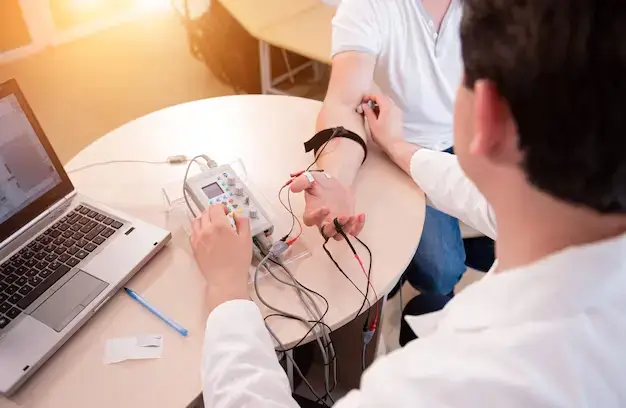
An EMG test in Cairo may be combined with a Nerve Conduction Study (NCS) to assess how peripheral nerves and muscles are functioning and to help determine whether symptoms are more consistent with a peripheral nerve, nerve root or muscle problem.

Before booking: the test should not be selected from symptoms alone. The clinician decides which study, nerves and muscles are relevant after reviewing the clinical question.
EMG test in Cairo with NCS nerve conduction testing
Direct answer

What are NCS and EMG tests?

A Nerve Conduction Study (NCS) evaluates how electrical signals travel through peripheral nerves using surface electrodes and brief electrical stimulation. Needle EMG records electrical activity from selected muscles using a fine needle electrode while the muscle is at rest and during contraction.

The two tests are often used together because they answer different parts of the diagnostic question. Results are interpreted alongside the medical history and neurological examination rather than as a stand-alone diagnosis.

01

Functional testing

They assess how nerves and muscles function rather than showing anatomy the way MRI or CT does.

02

Tailored to the clinical question

The number of nerves and muscles tested varies according to symptoms and what the clinician needs to clarify.

03

Not every numbness complaint needs EMG

Some causes of numbness or weakness may require blood tests, imaging or a different type of assessment.

Two complementary neurophysiology tests

NCS vs Needle EMG: what is the difference?

NCS evaluates signal conduction through peripheral nerves, while Needle EMG evaluates electrical activity within selected muscles.

NCS

Nerve Conduction Study (NCS)

Surface electrodes are placed on the skin. Brief electrical stimuli are applied to a nerve and the resulting nerve or muscle response is recorded.

  • Helps assess sensory and motor peripheral nerves.
  • May help localize slowing or reduced nerve conduction.
  • Can contribute to the assessment of carpal tunnel syndrome and selected peripheral neuropathies.
NEEDLE EMG

Electromyography (EMG)

A clinician places a fine needle electrode into selected muscles to record electrical activity at rest and during muscle contraction.

  • Helps assess muscles and selected motor nerve pathways.
  • May help distinguish a nerve-related problem from a primary muscle disorder.
  • The muscles tested are selected for the diagnostic question rather than following one fixed list for every patient.
When might a clinician consider testing?

Symptoms and conditions that may need neurophysiology assessment

Having one of these symptoms does not automatically mean an EMG or NCS is needed. The decision depends on the pattern of symptoms, neurological examination and the diagnostic question.

01

Persistent numbness or tingling

Especially when symptoms follow a particular nerve distribution or recur in the hands or feet.

02

Unexplained muscle weakness

When the clinician needs to assess whether the problem is more likely to be nerve-related or muscle-related.

03

Pain or burning in the limbs

In selected peripheral neuropathies or focal nerve compression syndromes.

04

Carpal tunnel syndrome

To assess the median nerve at the wrist when symptoms and examination support the clinical suspicion.

05

Pain radiating from the neck or back

NCS and EMG may form part of the assessment of selected nerve root disorders depending on the clinical picture.

06

Peripheral nerve injury or compression

To help identify the location and functional effect of a nerve problem in appropriate cases.

During your appointment

How are NCS and EMG performed?

The exact plan varies between patients. Testing begins by selecting the nerves and muscles that can answer the clinical question.

01

Review the symptoms

The clinician reviews where symptoms occur, how long they have been present and which structures need to be assessed.

02

Nerve conduction study

Surface electrodes are attached and brief electrical stimulation is used to record the speed and size of nerve responses.

03

Needle EMG when indicated

Selected muscles are examined using a fine needle electrode at rest and during contraction, depending on the clinical question.

04

Interpret the results

Measurements are interpreted together with symptoms and neurological examination to understand their clinical meaning and possible next steps.

Is an EMG or nerve conduction study painful?

During NCS, you may feel a brief electrical pulse or tapping sensation for a few seconds with each stimulus. Needle EMG may cause short-lived local discomfort when the fine needle electrode is inserted, and mild tenderness or a small bruise can occasionally remain afterward. The intensity varies from person to person.

Before the test

How to prepare for NCS / EMG

What should you do beforehand?

Preparation is usually straightforward, but good electrode contact with clean skin matters.

  • Shower or clean the skin before the appointment.
  • Avoid creams, oils and lotions on the areas likely to be tested.
  • Wear comfortable clothing that allows access to the arms, legs or required area.
  • Do not stop medication on your own before the test.

What should you tell the clinician?

Some information may change how the study is performed or what precautions are needed.

  • If you take blood-thinning medication or have a bleeding disorder.
  • If you have a pacemaker, defibrillator or another implanted electrical medical device.
  • All medications and supplements you currently use.
  • Any recent surgery or injury in the area being tested.
Understanding the report

What do NCS / EMG results mean?

The report is not simply “normal” or “abnormal.” The clinician reviews conduction speed, response amplitudes, electrical patterns within muscles and the distribution of any changes, then compares those findings with the symptoms and neurological examination.

The study may help indicate whether a problem is more consistent with a peripheral nerve, nerve root, muscle or another pattern, but NCS and EMG do not identify every cause of numbness or weakness. Blood tests, imaging or other investigations may still be needed.

Practical questions

Duration, safety and where the test is performed

01

How long does testing take?

There is no single fixed duration. It depends on how many nerves and muscles need testing and may range from around 30 minutes to an hour or longer in some cases.

02

Is it safe?

Nerve conduction studies are generally safe. Needle EMG is low risk; temporary discomfort or a small bruise may occur, while significant complications are uncommon.

03

Can I return to normal activity?

Most people can return to usual daily activity afterward, although mild local tenderness can occur after Needle EMG.

04

Clinic or home service?

Selected NeuroVisit nerve and muscle testing services may be available outside the clinic when the study type, clinical situation and required equipment are suitable.

Clinical interpretation

Dr. Karim Ashraf

Consultant Neurologist with an interest in neurophysiology and electrophysiological testing.

The value of NCS / EMG is not simply operating the equipment. Selecting the nerves and muscles that answer the diagnostic question, then interpreting the measurements within the patient’s clinical context, is an essential part of the study.

Doctorate in Neurology — Faculty of Medicine, Ain Shams University.
Master’s degree in Neurology — Faculty of Medicine, Ain Shams University.
Neurophysiology training — Cleveland Clinic.
Clear answers before your appointment

Frequently asked questions about NCS / EMG tests

Are NCS and EMG the same test?
No. NCS evaluates conduction through peripheral nerves using surface electrodes and brief electrical stimulation, while Needle EMG records electrical activity inside selected muscles with a fine needle electrode. They may be used together depending on the case.
Do I need to fast before NCS / EMG?
Routine fasting is usually not required. Follow any specific instructions provided for your appointment, particularly if another procedure is planned on the same day or you have a relevant medical condition.
Should I stop medication before the test?
Do not stop medication on your own. Tell the clinician about all medicines, especially blood thinners, and ask whether any specific preparation applies to your study.
Can NCS / EMG identify every cause of numbness?
No. These tests are useful for selected nerve and muscle disorders, but numbness can have other causes. Results are interpreted with the clinical assessment and additional testing may be needed.
Does having a pacemaker prevent NCS / EMG?
Tell the testing team in advance if you have a pacemaker, defibrillator or other implanted electrical device. The team can determine whether any precautions or changes to the testing plan are needed.
Are the results available immediately?
Measurements are generated during testing, but the final report requires interpretation and correlation with symptoms and examination findings. The team can tell you when to expect the report for your study.
Does NCS / EMG replace MRI?
No. NCS and EMG assess nerve and muscle function, while MRI shows anatomical structure. The appropriate test depends on the clinical question and sometimes both are useful.
Can some nerve and muscle tests be performed at home?
Selected NeuroVisit neurophysiology services may be available outside the clinic for suitable patients. Availability depends on the required study, the patient’s situation and the equipment needed.

Do you need an EMG test in Cairo or an NCS?

Book an assessment or send the written test request so the team can confirm the required study and preparation before your appointment.